Drayton Valley Drinking Water Treatment
Drayton Valley operates a municipal drinking water treatment plant serving a growing community under variable water conditions. As in many communities, this led to increased pressure to maintain water quality and control operating costs despite aging infrastructure and limited staffing.
In response, the town partnered with ISL Engineering to deploy RLCore's reinforcement learning control agents to optimize coagulant dosing and ultrafiltration backwashing, resulting in a 13% reduction in chemical usage and improved water quality and filter permeability.
The Drayton Valley plant was approaching a critical operational inflection point.
- Aging ultrafiltration membranes were operating at the limit of their original 10-year design life, increasing the risk of declining permeability or costly replacement.
- Coagulant dosing is traditionally managed through manual adjustment and setpoints, requiring constant human supervision and typically resulting in inefficiencies such and excessive chemical use or slow response to influent changes under variable raw water conditions.
- Backwashing strategies led to unnecessary water loss and inconsistent filter performance.
Operators needed to maintain strict water-quality targets without increasing chemical consumption, operating expenses, or workload.
Membrane replacement is a material capital expense, estimated at approximately $3 million every 10 years, underscoring the need to extend asset life.
The consulting engineers for Drayton Valley Water Treatment Plant sought to address these challenges by automating critical operations. They partnered with RLCore to to configure and deploy RLTune's advanced reinforcement learning (RL) agents capable of autonomous decision-making.
The Coagulation Control Agent managed polyaluminum chloride dosing to reduce chemical consumption while maintaining permeate UVT (Ultraviolet Transmittance) and pH at optimal levels.
A second Ultrafiltration Backwash Control Agent dynamically optimized backpulse flow and duration to maximize membrane permeability while minimizing water usage.
Both agents were integrated with the plant's HMI through a secure, OPC-based interface and included operator override and monitoring capabilities to ensure transparency and trust.
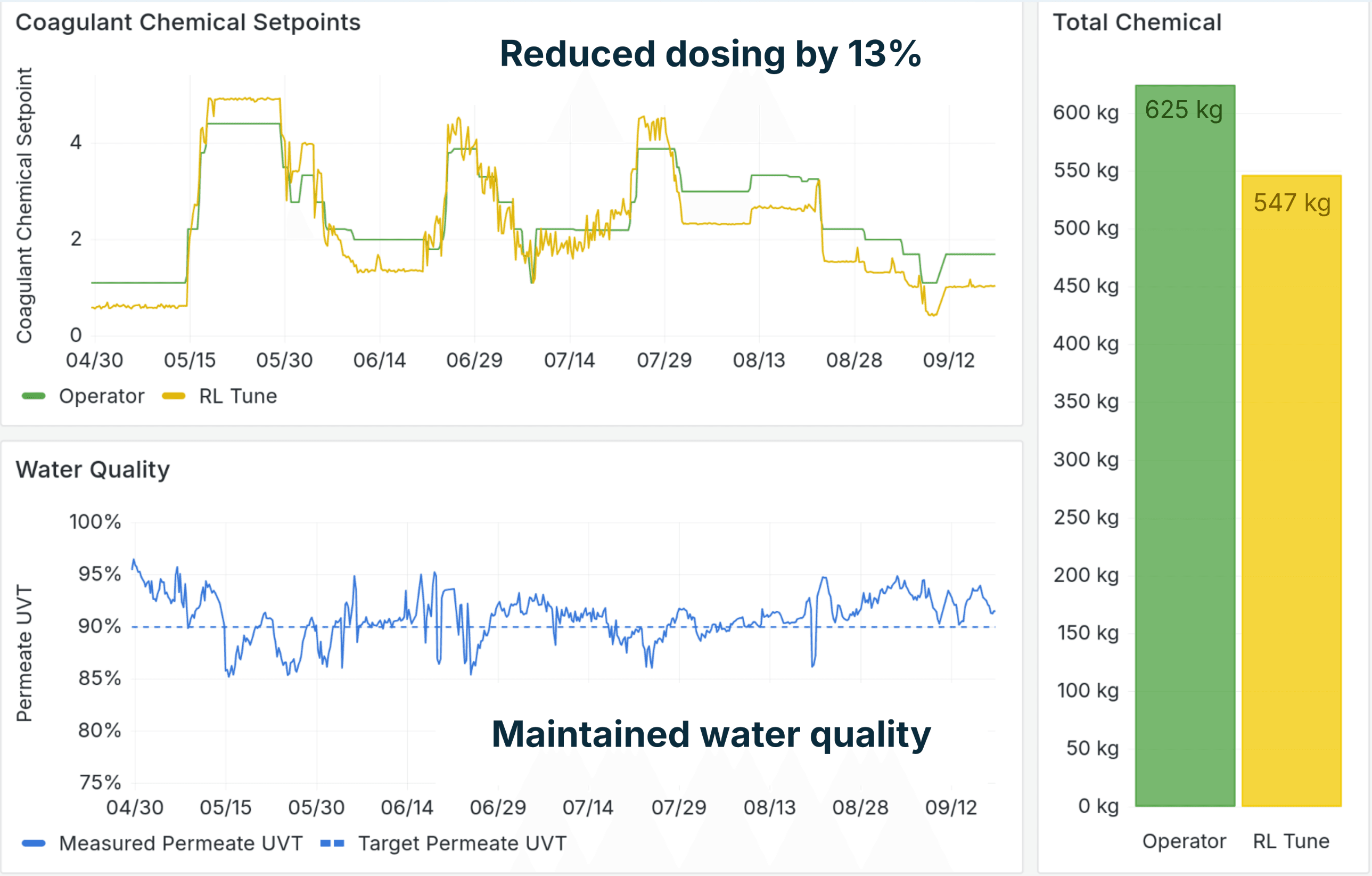
From May to September 2024, the RLTune coagulation agent proactively adjusted dosing in real-time in response changing influent water coming from the North Saskatchewan river. Over five months, this strategy conserved approximately 78 kg of polyaluminum chloride, a 13% reduction versus expected manual dosing, without compromising permeate water quality.
As shown in the figure below, when water quality decreased (decreased UVT), the RL agent proactively dosed higher than the slow-to-respond operator setpoint in order to improve permeate water quality. When water quality increased, the agent quickly decreased dosing in order to save chemical costs while maintaining output water quality.
Bottom Line
The integration of RLTune software into the Drayton Valley Water Treatment Plant’s control systems has shown that AI-driven automation can outperform traditional methods in both efficiency and adaptability. By reducing chemical usage while preserving water quality, the project demonstrated that intelligent control can deliver tangible environmental and economic benefits.
Future enhancements include leveraging fluorometer data (tryptophan and CDOM) for added sensor redundancy, ensuring continued reliability even in the event of individual sensor failures.
(1 / 1)