
EPCOR Gold Bar Wastewater Treatment Plant
EPCOR operates the Gold Bar Wastewater Treatment Plant, a critical regional asset serving the City of Edmonton. Given the plant’s proximity to residential areas, effective odor control is both an operational and community priority. Hydrogen sulfide scrubbers play a central role in mitigating odor emissions and maintaining air quality standards.
The plant struggled to meet scrubber efficiency targets under highly variable loading, leading to increased chemical dosing spend and burdensome, manual operator setpoint management. In response, EPCOR deployed RLTune software for real-time control of scrubber ORP, pH and make-up water flowrate setpoints, enabling them to achieve the ≥90% H₂S removal efficiency target while reducing chemical costs by ~25%, equating to ~$75K/year vs a fixed baseline (“no-agent”) scenario.

One of Gold Bar’s hydrogen sulfide scrubbers was consistently operating below target performance. Removal efficiency frequently fell below 80 percent, increasing the risk of odor excursions and resident complaints. Operators compensated by applying conservative chemical dosing strategies, which increased operating costs without reliably delivering consistent performance.
EPCOR’s Gold Bar Wastewater Treatment Plant operates several H₂S scrubbers to clean the exhaust air from the plant. One of these scrubbers was operating below its target level of efficiency (H₂S removed / H₂S in).
EPCOR’s objectives were to:
- Reliably achieve and maintain a >90% H2S removal efficiency target
- Improve air quality outcomes for the surrounding community
- Reduce chemical while hitting efficiency targets
- Preserve operator control, safety, and regulatory confidence
RLCore deployed their RLTune software, an advanced reinforcement learning (RL) agent, to automate and optimize the scrubber process. This AI-powered solution intelligently adjusted key setpoints, such as pH, oxidation-reduction potential (ORP), and softened water flow rate in real-time to meet the operator-defined and prioritized objectives to maximize H2S removal efficiency while minimizing chemical usage. Adjustments were made primarily based on data collected live as RLTune adjusted setpoints in real-time. EPCOR also provided historical data from operations prior to RLTune deployment, enabling the software to improve its reasoning about longer term historical trends.
This system was integrated with the plant’s HMI through a secure, OPC-based interface, and included operator override and monitoring capabilities to ensure transparency and trust.
Improved Scrubber Performance
Under RLTune control, the H2S Scrubber consistently met its primary goal of at least 90% scrubbing efficiency in 2025, achieving a median efficiency of 90.2% for the year.
In order to compare the performance of RLTune to the prior standard operating practice (SOP), a 2 week A/B test was conducted. In the first week (June 11 - June 18 2025) of this A/B test, the scrubber used SOP setpoints, and in the second week (June 18 - June 25 2025) the scrubber was under agent control. Under SOP control, the scrubber averaged ~81% efficiency with large swings (below the 90% target), while agent control stabilized performance and consistently met the 90% target.
Reduced Chemical Cost
In order to estimate the economic value of continually adapting dosing setpoints to the changing influent conditions, a second A/B test was conducted. In this test EPCOR calculated the average setpoint selected by the agent, and the performance of the agent was compared to this fixed setpoint. Fixed setpoints achieved a higher efficiency (93.5%) but at a materially higher cost; the agent achieved the target efficiency (91.5%) while spending ~25% less on chemicals (~$4.35k vs $5.8k over the week).
Operator Experience
Throughout the deployment, operators retained complete oversight and control through the HMI and SCADA. The system provided clear visibility into agent actions and decision logic, reinforcing trust and adoption.
By automating continuous tuning of scrubber setpoints, the agent reduced the need for frequent manual intervention while improving responsiveness to load variability.
Bottom Line
RLCore's RLTune software successfully met EPCOR’s primary goal by stabilizing H₂S scrubber efficiency at or above the 90% target (median 90.2% in 2025). Furthermore, the reinforcement learning agent delivered significant economic value, reducing chemical operating costs by approximately 25% compared to optimized fixed setpoint methods. This translates to an estimated annual saving of ~$75,000 for the single scrubber, while simultaneously reducing operator burden through automated, adaptive control. This case study demonstrates the capability of advanced AI control to optimize critical wastewater treatment processes for both environmental compliance and operational efficiency.
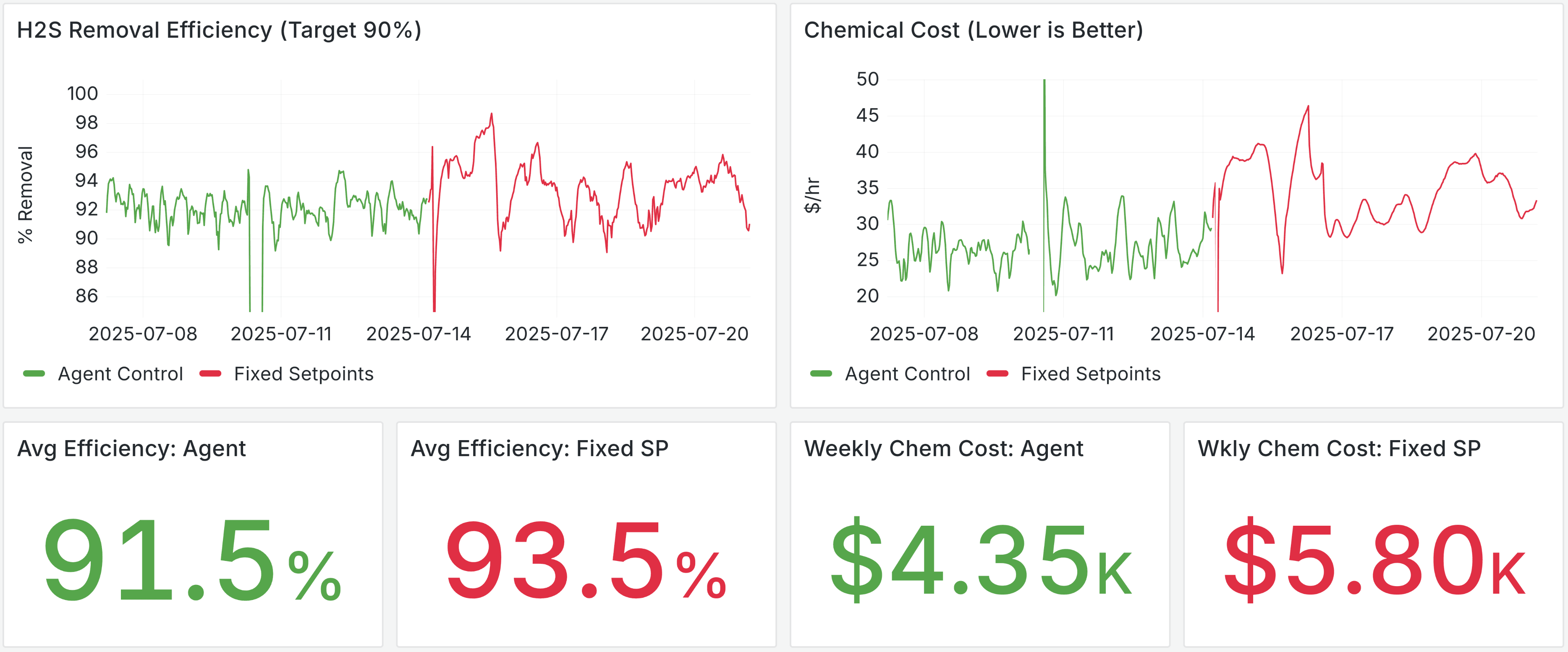
In the first week (June 11 - June 18 2025) of A/B test 1, the scrubber used SOP setpoints, and in the second week (June 18 - June 25 2025) the scrubber was under agent control. In the first week (July 07 - July 14 2025) of A/B test 2, the scrubber was under agent control, and in the second week (July 14 - July 21 2025) the scrubber used fixed setpoints. (1 / 2)